The Folding Tent of the Future: Research and Development at Pro-Tent
Products Are Continuously Improved
Pro-Tent follows a simple principle—perfection! Nowhere is this more evident than in product development. The company’s founder, Heinz Stöckler, was already a successful inventor. Among his many other inventions, the first aluminum folding frame originated from his sketchbook. While the first folding tent was designed on a drafting board back then, developers at Pro‑Tent now work with modern CAD programs.
Continuous Product Development
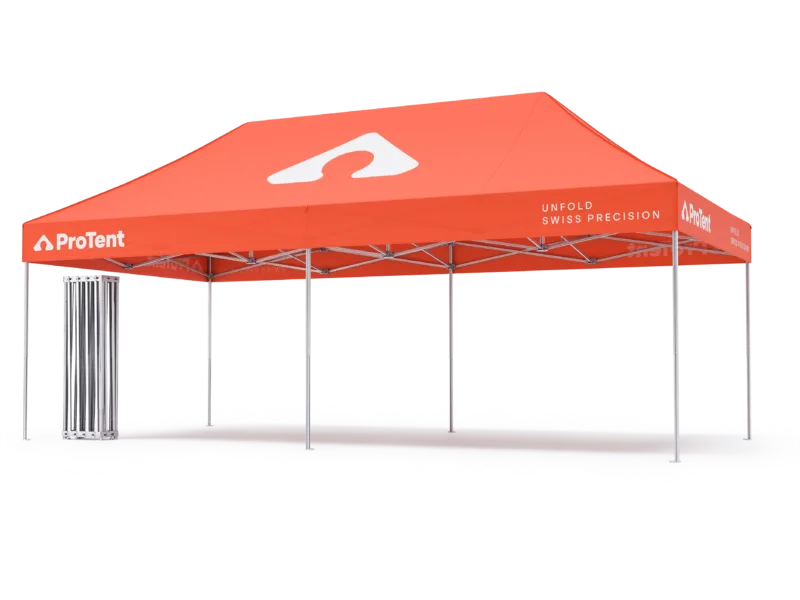
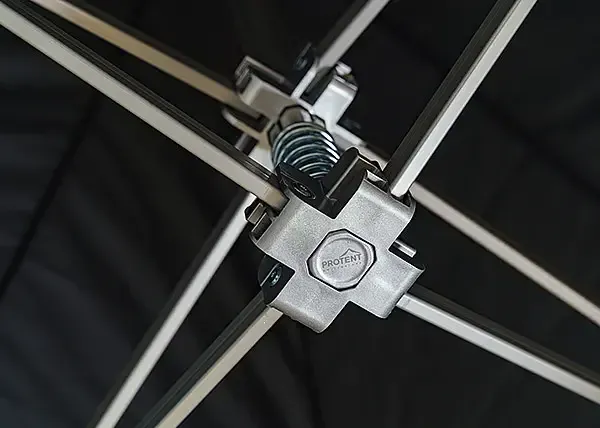
Today, the market for classic folding tents includes hundreds of suppliers. A large portion of these systems are cheap copies manufactured by the hundreds of thousands in Asia. Pro-Tent, on the other hand, has continuously refined its product and driven technical advancements and improvements with passion and a spirit of innovation. This has resulted in many unique products that set the standard in the industry. In addition, Pro‑Tent is the only folding tent manufacturer that focuses on frame design. As a result, Pro‑Tent’s folding frame today serves not only as the basis for a folding tent, but also for an exhibition stand and a room-in-room system.
Sustainable and Social Product Development
While Pro-Tent focused exclusively on functionality 30 years ago, our developers now think much more broadly. For example, we strive to make the development of our products as sustainable as possible by incorporating ecological, economic, and social aspects. When selecting raw materials, we prioritize ensuring that components can be recycled as effectively as possible after a maximally long life cycle or that their disposal results in minimal emissions. For this reason, we deliberately avoid using a PVC coating on our folding tent fabrics and opt for a PU coating instead.
Long Service Life as a Central Element of Development
A long service life is just as important. In most folding tents, the expensive aluminum profiles—which require significant energy to manufacture—are the biggest weak point. Pro-Tent therefore relies on glass-fiber-reinforced plastics instead of metal connectors. These are much lighter than metal connectors while offering comparable strength and can be precisely tailored to the aluminum profiles. This means that we use complex load case calculations to determine how long an aluminum profile can withstand the applied load. Based on this insight, the predetermined breaking points are calculated in the more affordable and easily replaceable plastic parts. In practice, this saves customers a significant amount of money in the event of damage, and the parts can be replaced quickly and easily.
Focus on Customer Needs
As a customer-oriented company, our customers’ suggestions and wishes are incorporated into product development just as much as our own experiences and ideas. One customer once remarked that at Pro-Tent, the quality and attention to detail are evident even in the packaging concept. We say: We simply like to see things through to the end.